
Entry in What Coverage a College Student Needs
Uninsured Motorist Coverage for College Students: Why It Matters
Learn why uninsured motorist coverage protects college students on and around campus, how state uninsured rates compare, and how to choose the right policy limits.

By Sophie Lindqvist · Editor
Published
Answer in brief
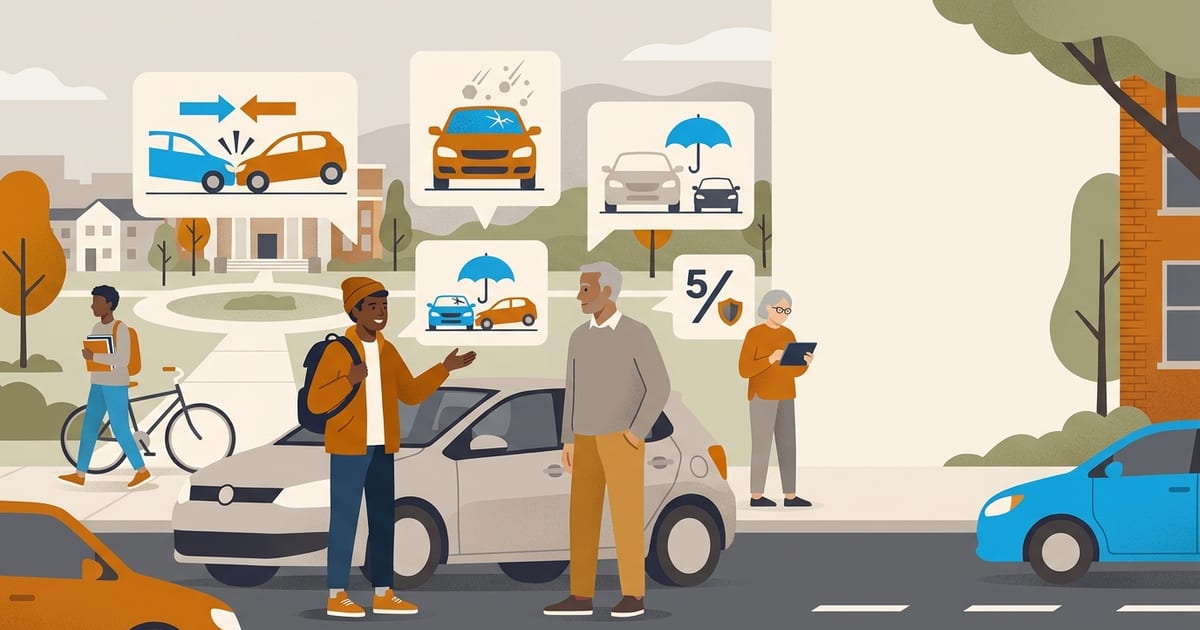
Uninsured motorist coverage shields college students from severe out-of-pocket medical and repair expenses if struck by a driver who carries no insurance or flees the scene. Because university towns bring together high traffic density and varying regional compliance rates, basic liability alone leaves young drivers financially vulnerable. Maintaining uninsured motorist limits that match your bodily injury protection ensures medical bills and car repairs do not derail your education.
Why Campus Commutes Increase Uninsured Driver Exposure
When young drivers move into college residence halls or off-campus apartments, their daily driving environment shifts drastically. College towns combine congested perimeter roads, crowded student parking structures, high pedestrian foot traffic, and an elevated proportion of younger drivers. According to the Insurance Information Institute, fatal-crash involvement per 100,000 licensed drivers reaches 42.40 for motorists ages 16 to 20 and 35.34 for those ages 21 to 24, compared to just 24.18 for drivers ages 35 to 44. Furthermore, research from the Insurance Institute for Highway Safety indicates that the fatal crash rate per mile driven for drivers ages 16 to 19 is just over three times higher than that for motorists ages 20 and older.
While what coverage a college student needs usually starts with standard liability to satisfy legal requirements, uninsured/underinsured motorist coverage is what protects you directly. Standard bodily injury liability pays for injuries you cause to others; it offers zero financial relief if another motorist hits your vehicle and lacks insurance. Campus hit-and-run incidents in student lots or crashes caused by non-compliant drivers can burden a student with extensive healthcare expenses and collision bills unless this coverage is in place.
State Uninsured Motorist Rates and Regional Risk
The danger of encountering an uninsured driver varies substantially by region. While every state enforces financial responsibility mandates, actual compliance ranges widely across the country. Data compiled by the Insurance Research Council and published by the Insurance Information Institute reveals sharp differences in the estimated share of uninsured motorists on the road in 2023.
| State | Estimated Uninsured Rate | Mandatory Stance / Protection Note |
|---|---|---|
| Mississippi | 28.2% | Highest recorded uninsured rate in the nation |
| New Mexico | 24.1% | Nearly one in four drivers lacks active coverage |
| District of Columbia | 23.1% | Urban traffic with high proportion of uninsured commuters |
| Michigan | 22.3% | High regional rate despite compulsory no-fault framework |
| Florida | 20.6% | More than one in five drivers operates without coverage |
| California | 20.4% | One in five drivers uninsured across major metros |
| Texas | 14.5% | Substantial uninsured exposure on major highway corridors |
| Maine | 5.7% | Lowest recorded uninsured driver rate in the country |
Students traveling to college in states like Mississippi, Florida, Michigan, or California navigate streets where one in five—or more—drivers has no auto policy at all. Even states that require auto insurance can see spikes in uninsured vehicles in off-campus university corridors. Recognizing this vulnerability, regulators in some jurisdictions have taken strict action. For instance, the North Carolina Department of Insurance implemented rules effective July 1, 2025, that require underinsured motorist coverage on all automobile policies issued or renewed in the state alongside an increase in mandatory liability minimums.
Matching Uninsured Limits to Your Liability Protection
A common error families make when setting up car insurance for college students is purchasing minimum legal limits to save money. The Insurance Information Institute explains that state financial responsibility limits represent an absolute legal floor, not a recommended financial strategy. If you carry standard bodily injury liability limits of $100,000 per person and $300,000 per accident, selecting low uninsured motorist limits—such as $25,000 or $30,000—creates an unbalanced safety net. It means you are providing more financial protection to strangers you might injure than you provide to your own student if a negligent, uninsured driver strikes them.
Insurers generally permit policyholders to purchase uninsured and underinsured motorist limits up to the amount of their third-party liability coverage. When balancing student budgets, pairing matching UM/UIM limits with an adjusted comprehensive or collision deductible provides superior protection. The Insurance Information Institute notes that raising a collision or comprehensive deductible from $200 to $500 can lower that coverage component by 15% to 30%, while shifting to a $1,000 deductible can reduce costs by 40% or more. The money saved by increasing physical damage deductibles can easily fund higher uninsured motorist limits that protect student health.
Steps to Add and Verify Uninsured Motorist Coverage
- 1
Review Your Current Declarations Page
Check your existing policy to identify whether uninsured motorist bodily injury (UMBI) and property damage (UMPD) are present, noting their exact split limits and per-accident caps.
- 2
Verify Campus Garaging Location
Confirm whether your insurer rates the vehicle at your parents' home or your campus residence. Uninsured motorist rates reflect local claim frequencies in the university's territory.
- 3
Request Matching UM/UIM Limits
Instruct your insurer or representative to set your uninsured and underinsured motorist bodily injury limits equal to your policy's primary bodily injury liability limits.
- 4
Compare Competitive Quotes
Collect quotes from at least three insurers to evaluate how different carriers price uninsured motorist endorsements for younger drivers.
How UM/UIM Interacts With Medical Payments and PIP
Understanding how uninsured motorist coverage fits alongside other policy features helps avoid duplicative costs while eliminating critical gaps. As outlined by the Insurance Information Institute, a basic auto policy can encompass several distinct medical and damage components: bodily injury liability, property damage liability, medical payments (MedPay), personal injury protection (PIP), collision, comprehensive, and uninsured/underinsured motorist coverage.
- Personal Injury Protection (PIP): In states with no-fault insurance statutes, PIP pays initial medical costs and partial lost income regardless of fault, but UMBI covers remaining medical expenses, severe disability, and pain and suffering once statutory PIP thresholds are exhausted.
- Medical Payments (MedPay): MedPay reimburses immediate medical or ambulance bills following a crash regardless of who was at fault, serving as a secondary buffer before or alongside health insurance, whereas UMBI provides broader compensation against an at-fault party without coverage.
- Collision Coverage vs. UMPD: If another driver damages your vehicle in a jurisdiction that does not offer uninsured motorist property damage, your own collision coverage steps in to repair or replace the car, subject to your policy deductible.
Questions & answers
Is uninsured motorist coverage mandatory for college students?
It depends on where the vehicle is registered and garaged. Some states mandate uninsured or underinsured motorist coverage by law, while others make it optional or require a signed waiver to reject it. Even where optional, consumer advocates strongly recommend carrying it due to high uninsured driver rates in many metropolitan and campus areas.
Does uninsured motorist coverage apply if a student is hit while walking on campus?
Yes. In most personal auto policies, uninsured motorist bodily injury coverage protects the named insured and resident family members if they are struck as pedestrians by an uninsured or hit-and-run vehicle.
Can a student stay on their parents' insurance to get cheaper UM coverage?
Yes. Enrolling on a parent's policy generally allows college students to access higher uninsured motorist limits at a more competitive household rate than purchasing an isolated standalone policy.
Terms: Uninsured/underinsured motorist coverage, Liability limits, State minimum, Deductible, Premium
Sources and references
Legal figures on this page (minimum limits, filing periods, statutory benefits) are checked against the primary law or the state insurance regulator listed below. Links and figures last verified Nov 2026.
- Changes to the rating of automobile insurance policies, effective July 1, 2025 — North Carolina Department of Insurance (2025)State insurance regulatorMinimum limits rose from 30/60/25 to 50/100/50 for policies issued or renewed on/after 1 July 2025; underinsured motorist coverage now included on all policies.
- Estimated percentage of uninsured motorists by state, 2017–2023 — Insurance Information Institute (2025)Statistical dataIRC time series by state; 2023: Mississippi 28.2%, New Mexico 24.1%, D.C. 23.1%, Michigan 22.3%, Florida 20.6%, California 20.4%, Texas 14.5%; lowest Maine 5.7%.
- Drivers in fatal motor vehicle crashes by age, 2023 — Insurance Information Institute (2025)Statistical dataFatal-crash involvement per 100,000 licensed drivers: 42.40 (16–20), 35.34 (21–24), 28.97 (25–34), 24.18 (35–44), 21.70 (45–54), 19.45 (55–64), 15.44 (65–74), 16.63 (75+).
- Fatality facts: Teenagers — Insurance Institute for Highway Safety (2024)Statistical dataFatal crash rate per mile driven for 16–19-year-olds is just over 3 times the rate for drivers 20 and older (2022 travel data); all-severity crash rate is over 4 times; risk is highest at 16–17.
- Automobile financial responsibility limits by state — Insurance Information Institute (2023)Statistical dataCompulsory coverages and minimum liability limits by state (table dated December 2023 — several states have raised limits since; see statute entries).
- What is covered by a basic auto insurance policy? — Insurance Information InstituteConsumer guidanceDefines bodily injury and property damage liability, MedPay, PIP, uninsured/underinsured motorist, collision, comprehensive and glass coverage.
- How much auto coverage do I need? — Insurance Information InstituteConsumer guidanceWhy state minimums are a floor; choosing liability limits that protect assets; when collision and comprehensive are worth keeping.
- Nine ways to lower your auto insurance costs — Insurance Information InstituteConsumer guidanceShop at least three quotes; raising a deductible from $200 to $500 can cut collision/comprehensive cost 15–30%, $1,000 can save 40%+; drop physical damage on cars worth under 10× the premium; bundling, low-mileage and good-student discounts.
Practical guidance on this page is original editorial work. Cited sources support factual statements and do not endorse this site. Dollar ranges described as typical or illustrative are editorial estimates, not figures from these sources.