
Guide
What Coverage a College Student Needs
Liability, uninsured motorist, collision and comprehensive, and deductibles for a student's car—on a family policy or alone.

By Sophie Lindqvist · Editor
Published · Updated
Answer in brief
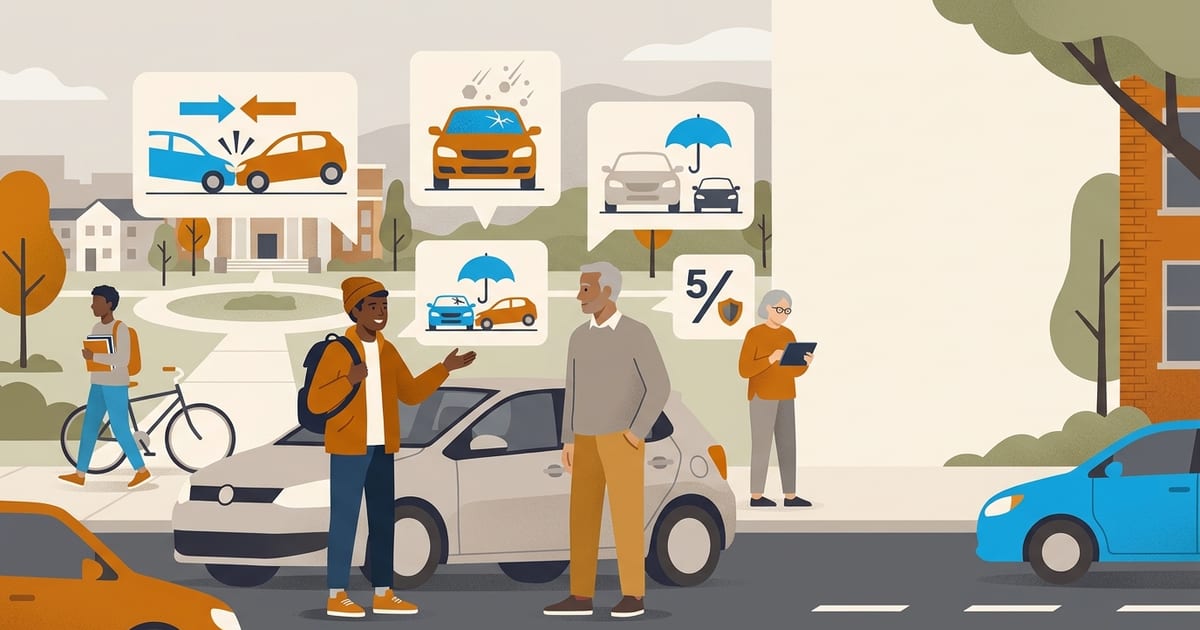
A college student's car should carry liability above the state minimum (50/100/50 at least; 100/300/100 on a family policy where household assets are exposed), uninsured motorist at matching limits, and comprehensive almost always (campus theft and vandalism). Collision depends on the car's value: keep it on anything financed or worth more than about $5,000 with a $1,000 deductible; on an old car, liability plus comprehensive is often the right trade.
Liability on a family policy
When a student is on a parent's policy, the parents' assets stand behind the student's driving. That argues for 100/300 or higher. On a student's own policy with few assets, 50/100 is a reasonable floor—but a serious at-fault crash can still produce a judgment that follows a graduate into their working years.
Why comprehensive, even without collision
Campus cars are parked outdoors, in dense lots, for long periods. Theft, break-ins, vandalism and weather are the typical claims, and comprehensive is cheap—often a quarter of collision's cost.
Entries in this guide
Specific questions answered in more depth.
Questions & answers
Does a college student need full coverage?
Comprehensive almost always; collision if the car is financed or worth more than about $5,000.
What liability limits should a student have?
100/300 on a family policy; at least 50/100 on their own.
Is roadside assistance worth it for students?
Usually—it is inexpensive and students are often far from family help.
Terms used in this guide
- Liability limits
- The maximum paid for injuries and damage you cause, e.g. 100/300/100 in thousands.
- Comprehensive coverage
- Theft, vandalism, weather, fire, animal strikes, glass—the common campus claims.
- Deductible
- What you pay before collision or comprehensive pays.
- Uninsured/underinsured motorist coverage
- Pays for your injuries when the at-fault driver has no or too little insurance.
Sources and references
Legal figures on this page (minimum limits, filing periods, statutory benefits) are checked against the primary law or the state insurance regulator listed below. Links and figures last verified Nov 2026.
- Teenagers — Insurance Institute for Highway SafetyIndependent researchTeen crash risk, graduated driver licensing research and vehicle recommendations for young drivers.
- Facts + Statistics: Uninsured motorists — Insurance Information Institute (2024)Statistical dataInsurance Research Council estimates of uninsured drivers by state (2022: e.g. Michigan 19.6%, California 17.0%, Florida 15.9%, Texas 13.8%).
- Automobile financial responsibility limits by state — Insurance Information Institute (2023)Statistical dataCompulsory coverages and minimum liability limits by state (table dated December 2023 — several states have raised limits since; see statute entries).
- What is covered by a basic auto insurance policy? — Insurance Information InstituteConsumer guidanceDefines bodily injury and property damage liability, MedPay, PIP, uninsured/underinsured motorist, collision, comprehensive and glass coverage.
- How much auto coverage do I need? — Insurance Information InstituteConsumer guidanceWhy state minimums are a floor; choosing liability limits that protect assets; when collision and comprehensive are worth keeping.
- Is it legal to drive without insurance? — Insurance Information InstituteConsumer guidanceEvery state requires drivers to demonstrate financial responsibility; in most states insurance is the mandatory way to do so.
- Auto insurance for teen drivers — Insurance Information InstituteConsumer guidanceAdding a teen to a parent's policy versus a separate policy; good-student and driver-training discounts; vehicle choice.
- Nine ways to lower your auto insurance costs — Insurance Information InstituteConsumer guidanceShop at least three quotes; raising a deductible from $200 to $500 can cut collision/comprehensive cost 15–30%, $1,000 can save 40%+; drop physical damage on cars worth under 10× the premium; bundling, low-mileage and good-student discounts.
Practical guidance on this page is original editorial work. Cited sources support factual statements and do not endorse this site. Dollar ranges described as typical or illustrative are editorial estimates, not figures from these sources.
Guide
Taking a Car to College: Insurance Changes
What changes when a student takes a car to school—garaging address, territory, campus parking risk, comprehensive coverage, and who else may drive it.
Guide
Car Insurance for College Students Without a Car
Whether a student without a car needs insurance—driving friends' cars, rentals, car-sharing, non-owner policies—and how to keep coverage history continuous.
Guide
How to Compare Car Insurance as a College Student
A comparison method for students and their families: decide parents' policy vs own first, fix coverage, apply student discounts, use the right garaging address, and gather several quotes.