
Entry in Car Insurance for Out-of-State College Students
Out-of-State College Student Car Insurance: Rules and Coverage Guide
Understand out-of-state car insurance rules for college students, including garaging address updates, state minimum liability changes, and multi-state rating rules.

By Sophie Lindqvist · Editor
Published
Answer in brief
Taking a vehicle across state borders for college requires coordinating your family policy rules, garaging locations, and local liability mandates. While full-time students typically keep their parents' home as their permanent legal residence, insurers require an accurate campus garaging address to determine rating territories and ensure valid claims. Understanding how out-of-state moves affect mandatory coverage thresholds prevents costly coverage denials during your college years.
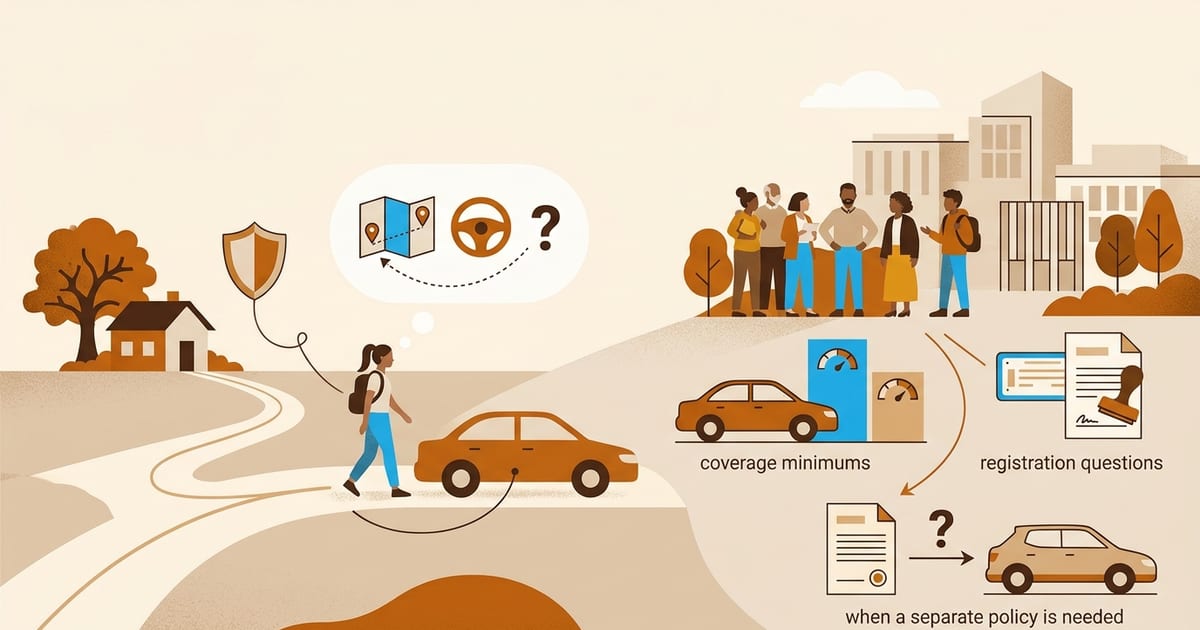
How Crossing State Lines Affects College Auto Insurance
When a student packs a car and heads to a university in another state, auto insurance cannot simply remain on autopilot. Every state regulates motor vehicle insurance within its own borders, establishing distinct baseline rules for financial responsibility, minimum coverage limits, and territory rating structures. While a full-time student generally retains their childhood home as their permanent address, bringing a car onto an out-of-state campus establishes a new operational base that policy underwriters must evaluate.
Failing to notify your insurance company about an out-of-state vehicle relocation can jeopardize claim payouts. If an accident occurs near campus and the insurer discovers the vehicle has been housed hundreds of miles away in another state for nine months of the year without notice, the carrier may investigate for material misrepresentation. Maintaining transparent communication with your carrier ensures your policy honors legitimate claims and satisfies legal requirements in both your home state and your school's host state.
Garaging Address vs. Permanent Residence
To insure an out-of-state student correctly, families must understand the clear regulatory distinction between where a driver lives legally and where a vehicle is kept overnight. Confusing these terms often leads to rating errors or policy discrepancies.
- Permanent Residence: The primary domicile where the student pays taxes, votes, and returns during summer breaks. For most undergraduates, this remains the parent household.
- Garaging Address: The exact physical location—such as a university dormitory parking lot or off-campus apartment garage—where the automobile is parked for the majority of the academic calendar.
- Rating Territory: The geographic zone defined by underwriters to calculate risk based on local population density, crash frequencies, severe weather, and vehicle theft statistics. Moving a vehicle from a rural hometown to an urban university campus alters the vehicle's rating territory even if the policyholder remains unchanged.
According to the Insurance Information Institute, an auto policy's price is determined by rating factors such as driving record, annual mileage, vehicle type, and vehicle location. Notably, while California and Michigan prohibit territory rating based on ZIP codes, location remains a core pricing factor across most of the United States. Changing your garaging address to an out-of-state campus adjusts your baseline premium to reflect the risk environment where the vehicle is actually driven.
State Minimum Liability Limits Across State Lines
One of the most critical aspects of car insurance for out-of-state college students is understanding how baseline liability limits change from state to state. Under standard personal auto policies, an 'out-of-state coverage provision' automatically broadens your liability coverage to meet higher statutory limits if you drive into a state that requires greater minimum protection than your home policy provides. However, relying on this provision without updating your policy structure can create misunderstandings regarding physical damage and optional benefits.
As demonstrated by recent state legislative updates, minimum requirements are trending significantly higher. In Virginia, Va. Code § 46.2-472 sets minimum limits for policies effective on or after January 1, 2025, at $50,000 per person and $100,000 per accident for bodily injury, alongside $25,000 for property damage. In California, Cal. Veh. Code § 16056 established minimum liability limits for policies issued or renewed on or after January 1, 2025, at $30,000 per person, $60,000 per accident, and $15,000 for property damage, with limits rising further on January 1, 2035. Meanwhile, the North Carolina Department of Insurance enacted changes effective July 1, 2025, raising minimum thresholds from 30/60/25 to 50/100/50 while mandating underinsured motorist coverage on all automobile policies.
Can a Student Remain on the Family Policy When Moving Out of State?
In the vast majority of situations, yes. A student who attends college out of state as a full-time student can typically continue staying on their parents' car insurance. Because university enrollment is considered a temporary absence from the family home, insurers do not treat the undergraduate as having permanently established an independent household.
Keeping the student on the primary family policy usually offers distinct financial advantages compared to buying an individual, standalone policy in the host state:
- Multi-Car Discounts: Insuring the student's car alongside parental vehicles preserves substantial multi-vehicle account credits.
- Shared Liability Umbrella: The student remains protected under higher family liability umbrellas rather than carrying vulnerable state minimums on a low-cost independent policy.
- Student Discounts: The family policy can still take advantage of the good student discount if the student maintains qualifying grades while studying away.
Action Steps Before Taking Your Car Across State Lines
- 1
Notify Your Current Insurance Carrier
Inform your insurer that your student will be attending college out of state, providing the exact school name, residence address, and planned dates of attendance.
- 2
Provide the Campus Garaging Address
Supply the street address or ZIP code where the vehicle will be parked overnight to allow underwriters to update the vehicle's rating territory accurately.
- 3
Verify State Law and Registration Rules
Check whether the host state requires students to register vehicles locally after a specified timeframe or if they grant full reciprocity to out-of-state students maintaining valid home-state registration.
- 4
Shop and Compare Coverage Options
Obtain comparative quotes from competing carriers. According to the Insurance Information Institute, shopping at least three quotes is critical, especially when an out-of-state territory alteration impacts your annual premium.
Vehicle Registration and Licensing for Out-of-State Students
Beyond the insurance policy itself, students must comply with state licensing agency regulations. Most states grant reciprocal privileges to non-resident, full-time college students, allowing them to keep their home-state vehicle registration and driver's license as long as they maintain active student status and do not seek permanent employment in the host state. However, the car title, registration, and insurance policy must remain tightly aligned.
If your parents own the vehicle and hold the title in your home state, the primary policy must generally remain in their names. Setting up a standalone policy in a new state while the car is titled in another person's name back home can cause serious underwriting friction. Keeping the insurer fully informed of the car's title holder and garaging location eliminates these administrative obstacles.
Questions & answers
Do I need to change my driver's license when going to college out of state?
In most states, full-time students who maintain their primary residence at their parents' home are not required to change their driver's license to the host state, provided they remain enrolled in an accredited college or university.
Will moving to an out-of-state campus raise our car insurance premium?
It depends on the rating territory of the campus. Moving a vehicle from a quiet rural town to a densely populated metropolitan campus often increases rates due to higher claim frequencies, while moving from a major city to a small rural college town may lower costs.
What happens if I forget to update the garaging address with my insurer?
Failing to report an out-of-state garaging address can result in delayed claims, disputed payouts, or coverage cancellation for material misrepresentation if an accident occurs where the vehicle is routinely kept.
Terms: Permanent address, Garaging address, Rating territory, State minimum, Full-time student
Sources and references
Legal figures on this page (minimum limits, filing periods, statutory benefits) are checked against the primary law or the state insurance regulator listed below. Links and figures last verified Nov 2026.
- Vehicle Code § 16056 — minimum liability limits — California Legislative Information, Cal. Veh. Code § 16056Primary lawPolicies issued or renewed on/after 1 Jan 2025: $30,000 per person / $60,000 per accident bodily injury / $15,000 property damage. From 1 Jan 2035 the limits rise by $20,000 / $40,000 / $10,000 (to 50/100/25).
- Va. Code § 46.2-472 — minimum liability limits — Virginia Law (LIS), Va. Code § 46.2-472Primary lawFor policies effective on/after 1 Jan 2025: $50,000 per person / $100,000 per accident bodily injury / $25,000 property damage.
- Changes to the rating of automobile insurance policies, effective July 1, 2025 — North Carolina Department of Insurance (2025)State insurance regulatorMinimum limits rose from 30/60/25 to 50/100/50 for policies issued or renewed on/after 1 July 2025; underinsured motorist coverage now included on all policies.
- Automobile financial responsibility limits by state — Insurance Information Institute (2023)Statistical dataCompulsory coverages and minimum liability limits by state (table dated December 2023 — several states have raised limits since; see statute entries).
- What is covered by a basic auto insurance policy? — Insurance Information InstituteConsumer guidanceDefines bodily injury and property damage liability, MedPay, PIP, uninsured/underinsured motorist, collision, comprehensive and glass coverage.
- How much auto coverage do I need? — Insurance Information InstituteConsumer guidanceWhy state minimums are a floor; choosing liability limits that protect assets; when collision and comprehensive are worth keeping.
- What determines the price of an auto insurance policy? — Insurance Information InstituteConsumer guidanceRating factors: driving record, mileage, location, age, gender, vehicle, credit-based insurance score, coverage choices. Notes ZIP-code rating is prohibited in California and Michigan and gender rating is prohibited in seven states.
- Nine ways to lower your auto insurance costs — Insurance Information InstituteConsumer guidanceShop at least three quotes; raising a deductible from $200 to $500 can cut collision/comprehensive cost 15–30%, $1,000 can save 40%+; drop physical damage on cars worth under 10× the premium; bundling, low-mileage and good-student discounts.
Practical guidance on this page is original editorial work. Cited sources support factual statements and do not endorse this site. Dollar ranges described as typical or illustrative are editorial estimates, not figures from these sources.